RUSSIAN AGGRESSION


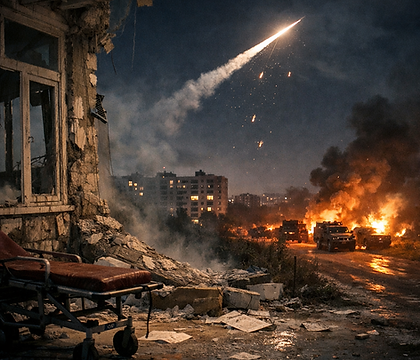
Timeline of Russia's invasion of Ukraine - Part 93. May/June 2023
Guerilla operations continued in the Belgorod region, forcing the Kremlin to declare a state of anti-terrorist operation, while in eastern Ukraine heavy fighting moved to the flanks of Bakhmut and the Toretsk area, where Russian missiles destroyed civilian infrastructure.
The head of the Wagner Group, Yevgeny Prigozhin, in a surprisingly frank interview admitted that over 20,000 of his fighters had been killed in the battle for the city and openly confirmed the killing of civilians by the Russian military. In response to these brutal actions, on May 23, the European Union announced the transfer of 220,000 artillery shells, and Poland declared its full readiness to begin training Ukrainian pilots on the F-16, which accelerated the construction of Ukraine's new air security architecture.
On May 24, during a vote at the World Health Organization (WHO), 80 countries condemned Russian aggression and attacks on medical facilities, isolating Russia and its few allies, such as China and North Korea, in the global forum.
On May 25, as part of another prisoner exchange, 106 Ukrainian defenders returned home, including many captured in the dramatic circumstances of the battle for Bakhmut. At the same time, the geopolitical situation was exacerbated by the signing of an agreement between Moscow and Minsk on the deployment of Russian tactical nuclear weapons in Belarus. In response to this threat, during another Ramstein meeting, the Allies reaffirmed their determination to train pilots and provide anti-aircraft systems, and Finland announced its 16th aid package worth €109 million.
On May 26, tragic consequences were reported following a Russian missile strike on a medical facility in Dnipro, which resulted in three deaths and over thirty injuries. Russia carried out a massive attack using seventeen missiles and over thirty Shahed drones, mainly targeting infrastructure in Kharkiv and Kyiv.
On May 29, Mykhailo Podolyak announced the entry of the conflict into a new phase, being a systematic destruction of Russian supply lines, as exemplified by the precision Storm Shadow attack on barracks near Mariupol, where enemy losses were estimated at hundreds of soldiers.
The end of the month brought a historic breakthrough in the form of a drone attack on Moscow, where several airborne vehicles struck residential buildings in prestigious districts, forcing Vladimir Putin to publicly try to downplay the incident. On the southern front, the Russians continued to militarize Enerhodar, converting industrial plants into ammunition depots and repair bases, ignoring appeals from the International Atomic Energy Agency. Ukrainian intelligence reported the construction of gigantic morgue complexes in Kursk and Rostov, confirming that the scale of the aggressor's losses had become impossible to conceal even from the Russian public. The month closed with another aid package from the US worth three hundred million dollars and the announcement by the Freedom of Russia Legion about the recruitment of thousands of volunteers ready for further operations in the territory of the Russian Federation.
June began with a nighttime rocket attack on Kyiv that killed three people, including a child. The tragedy sparked a nationwide debate about the availability of shelters, as victims were killed just in front of the locked doors of a secure facility. At the same time, in the territory of the Russian Federation, in the Belgorod region, there was an intensification of guerilla activities conducted by the Freedom of Russia Legion and the Russian Volunteer Corps. The militants attacked Shebekino using Grad systems, destroying a column of Russian equipment and forcing the Russian command to use heavy artillery and TOS-1A thermobaric systems in their own territory.
On the night of Jun. 2-3, the Ukrainian capital endured two more waves of airstrikes, in which a total of fifteen cruise missiles and twenty-one Shahed drones were shot down. In the south of the country, Ukrainian missiles hit the port of Berdyansk, a key logistics point used by the occupiers to export looted property. In parallel, the Pentagon announced the purchase of Starlink satellite services for Ukraine, to ensure reliable communications for the military without depending on Elon Musk's direct decisions. Another important military signal was the start of Ukrainian crews' training on American M1 Abrams tanks, which coincided with the intensification of fighting in the Marinka area, where Chechen special units "Akhmat" were sent to the offensive.
Illustrative photo/AI generated
See more


The task is financed by the Minister
