RUSSIAN AGGRESSION


Chronicle of the Russian Invasion of Ukraine – Part 76. August 2024
The Ukrainian operation in Kursk Oblast enabled Kyiv to seize the operational initiative, forcing Russian command to hastily reinforce its defences with understrength units of low combat readiness. According to assessments by the Institute for the Study of War (ISW), Vladimir Putin entrusted coordination of the so-called “counterterrorism operation” to Alexander Bortnikov, indicating a shift in Kremlin priorities from conventional warfare toward safeguarding domestic stability.
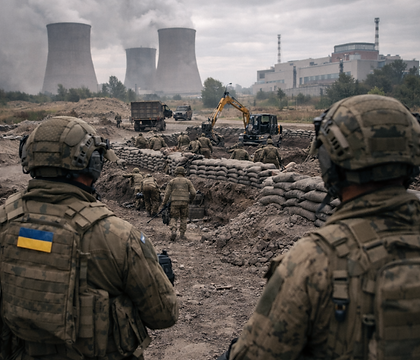
Ukrainian units advanced into the Belovsky District, with reconnaissance elements detected as far as 30 kilometres from the border. In response, Russia began constructing improvised defensive lines near the Kursk Nuclear Power Plant, raising concerns about the safety of a nuclear facility amid ongoing hostilities.
During the night, Russia carried out a massive missile strike against Ukraine, employing, inter alia, four North Korean KN-23 ballistic missiles. Although they failed to reach their intended targets in Kyiv, one missile fell in the Brovary area, killing a 35-year-old man and his four-year-old son. The strike became another documented instance of a child’s death resulting from the use of long-range weapons against civilian areas. That evening, a dangerous incident occurred at the Zaporizhzhia Nuclear Power Plant, where Russian forces set tyres alight inside a cooling tower. President Volodymyr Zelenskyy described the act as a form of nuclear blackmail and an attempt to provoke international panic.
On 12 August, the Commander-in-Chief of the Armed Forces of Ukraine, General Oleksandr Syrskyi, officially reported that Ukrainian troops had taken control of approximately 1,050 km² of Russian territory. Full control over the centre of Sudzha and the village of Daryino was confirmed. The scale of operations compelled Russian authorities to evacuate more than 120,000 residents from Kursk Oblast and to initiate forced departures of inhabitants from the Krasnoyaruzhsky District in Belgorod Oblast. A further embarrassing incident occurred within Russian aviation when a Ka-52M attack helicopter, due to crew error, fired upon its own column, destroying a Msta-S self-propelled artillery system.
On 13 August, President Zelenskyy announced that Ukraine now controlled 74 localities in Kursk Oblast and that hundreds of Russian soldiers had been captured during the operation. Despite these losses, Russia maintained pressure in Donbas, capturing Ivanivka and advancing toward the outskirts of Toretsk. The reduced intensity of ground assaults was offset by increased use of KAB glide bombs, which repeatedly struck built-up areas, driving up civilian casualties.
On the diplomatic front, Ukraine’s Ministry of Foreign Affairs emphasised that the Kursk operation was a direct consequence of Western states’ failure to authorise Ukraine’s use of long-range weapons against targets deep inside Russia. Kyiv underscored that it did not seek to annex Russian territory, but rather to establish a buffer zone protecting Sumy Oblast from artillery and missile attacks. At the same time, Lithuania confirmed that Russia was redeploying troops from Kaliningrad Oblast to Kursk Oblast, thereby weakening Russia’s military posture along NATO’s borders.
In the days that followed, Ukrainian forces continued their advance in Kursk Oblast, pushing several additional kilometres forward and capturing a record number of 100 Russian soldiers in a single day. The clearance of Sudzha was completed, and Ukrainian public television broadcast a report from the city documenting the delivery of humanitarian aid to civilians and the extent of destruction left by the Russian administration. Lacking the capability for effective manoeuvre defence, Russia began digging trenches and erecting fortifications as far as 75 kilometres from the state border.
The United States and Germany stated that they were closely monitoring developments, recognising the Kursk operation as an element of Ukraine’s sovereign defensive strategy and not questioning its legality under the right of self-defence.
Illustrative photo generated by AI
See more


The task is financed by the Minister
