RUSSIAN AGGRESSION


Timeline of Russia's invasion of Ukraine - Part 107. January 2025
Mid-January 2025 brought a critical deterioration of the operational situation in the Donbas, successes in the Ukrainian "drone warfare" against the Russian energy sector, and controversies around personnel reforms in the Ukrainian army.
On Jan. 11 and 12, Kurakhove was completely seized by Russian forces. The loss of this "logistical heart" of the region opened the way for the Russians to further outflank Pokrovsk. In Toretsk, where the Russians had controlled about 70-95% of the area, the Ukrainians noticed new, perfidious methods of warfare: Russian soldiers were dressing up in civilian clothes, which constituted a war crime, while making it more difficult for Ukrainian drone operators to identify targets. At the same time, the first live North Korean prisoners were captured near Kursk, providing evidence of the direct involvement of Kim Jong Un's forces.
The situation near Pokrovsk led to the suspension of extraction operations at the Pokrovsk mine – the only plant in Ukraine producing coking coal. This was a blow to the Ukrainian steel industry, which was key to arms production. Tensions had erupted within the Armed Forces of Ukraine following General Syrsky's order to transfer 5,000 Air Force soldiers (including air defence specialists) to infantry units. This raised concerns about weakening the protection of the skies over Kyiv. President Zelensky had to intervene, ordering the command to suspend transfers of key specialists.
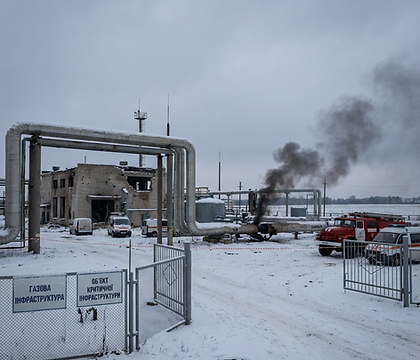
On Jan. 15, Russia attacked gas infrastructure in western Ukraine (Drohobych and Stryi regions). Although anti-aircraft defences shot down a significant portion of the missiles, critical facilities were damaged, causing local power outages.
Prime Minister Keir Starmer's visit to Kyiv on Jan. 16 brought the signing of a historic 100-year partnership and a £4.5 billion aid package, including Gravehawk anti-aircraft systems. On the technological front, Ukraine boasted of producing 30,000 Baba Yaga-type drones capable of operating at night.
In response to Russian pressure, Ukrainian long-range drones struck an oil depot in Lyudinovo (Kaluga region). Satellite data confirmed widespread fires at a site located just 180 km from the border. At the same time, Ukrainian intelligence reported a decline in Russian exports of petroleum products by over 9%, which was a direct result of the systematic destruction of the oil refining infrastructure.
The day of Donald Trump's inauguration as the 47th President of the United States coincided with declarations of willingness to immediately end the war through negotiations with Vladimir Putin. In Europe, opinions were divided – President Macron warned against illusions of a quick peace, while Prime Minister Fico expressed scepticism about Ukraine's ability to regain the occupied territories. In Ukraine, law enforcement agencies (SBU and SBI) made spectacular arrests: two generals and a colonel were charged with negligence that had allowed the Russians to breach the border in the Kharkiv region in May 2024. This was a signal of tightening discipline in the highest command in the face of the critical situation near Pokrovsk, where Russian forces had captured another locality – Kotlyne.
The situation around Velyka Novosilka became critical as the city was almost completely blocked on three sides. The evacuation of civilians became possible only through the fields to the north-west, which in winter conditions, with the swollen Mokri Yaly river, posed a deadly threat. The Russians also made progress near Pokrovsk, seizing the villages of Zelene and Vidrodzhennya.
One of the most intense battles with the participation of North Korean troops took place in the Kursk region. Ukrainian Special Operations Forces repelled the assault for 8 hours, eliminating several dozen North Korean soldiers. Successes were also recorded behind enemy lines, where drones struck the Smolensk Aviation Plant, where Su-25 aircraft were serviced.
On the morning of Jan. 23, Russian ballistic missiles struck a multi-story residential building in Zaporizhzhia. At least 45 people were injured in the attack. Among them was a 2-month-old baby who miraculously survived under the rubble, and four children. Four DSNS rescuers who were providing assistance to the victims also sustained injuries.
At the same time, in the Kharkiv region, due to the imminent threat of Russian troops entering Kupiansk, the authorities announced the forced evacuation of 267 children and their families. The children, often roused from sleep, left their homes under the cover of darkness and were transported to safer shelters inland.
Illustrative photo/AI generated
See more


The task is financed by the Minister
