RUSSIAN AGGRESSION


Timeline of Russia's invasion of Ukraine - Part 101. June/July 2023
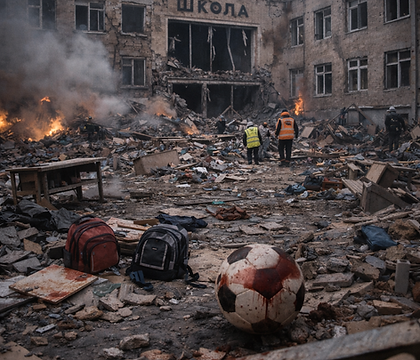
On Jun. 29, the Russian army launched a massive shelling attack on residential areas of Kherson, hitting a medical facility and a school serving as a humanitarian aid distribution centre.
As a result of the attack, two people were killed, and a total of three fatalities were reported in the entire Kherson region that day. Further S-300 missiles fell on civilian infrastructure in Zaporizhzhia and Chuhuyevo. General Serhiy Nayev described the Sumy region as the most dangerous in the north of the country due to constant border shelling and called on residents to evacuate.
The World Bank declared financial support for Ukraine, approving a loan of $1.5 billion for the reconstruction of the country and support for households. The Japanese government was the guarantor of this aid. At the same time, the US administration confirmed that it was considering transferring cluster munitions to Ukraine, which would be crucial for breaking through Russian defence lines.
The last day of June brought further tragic reports of attacks on school infrastructure and children. A Russian Iskander-K missile hit a school in the locality of Serhiivka in the Donetsk region, killing two people and injuring six. In Antonivka, a family with a child was injured as a result of shelling of a residential building. Ukrainian military intelligence warned of a growing threat at the Zaporizhzhia Nuclear Power Plant, saying Russian personnel had been instructed to leave the facility by Jul. 5.
In the occupied territories, the practice of using civilians as "human shields" intensified. In the locality of Topolivka, the Russian command quartered soldiers in private homes where the residents were still staying.
In early July, Russian offensive operations concentrated on the directions of Lyman, Bakhmut, Avdiivka and Marinka, where Ukrainian forces repelled 46 attacks. Within 24 hours, the Russian army carried out one missile attack, 27 airstrikes and approximately 80 rocket shellings, targeting both military positions and populated areas. As a result of shelling in Mala Tokmachka, one person was killed, and in Balaklia four people were injured after an attack with Tornado missiles. The Ukrainian General Staff reported on the drastic methods used by the occupier to cover up the traces of losses. A 24/7 mobile crematorium had been launched in Berdyansk, which also served to deprive the families of fallen Russian soldiers of the right to compensation.
The situation around the Zaporizhzhia Nuclear Power Plant remained tense – the mayor of Enerhodar reported that around 100 Rosatom employees had left the facility, which was consistent with previously observed signals of possible preparations for a provocation. The British Ministry of Defence highlighted the scale of the humanitarian catastrophe: since the beginning of the invasion, as much as 25% of Ukraine's pre-war population had been forced to leave their homes, and the number of refugees outside the country had reached 6.3 million.
Jul. 3 brought a tragic attack by four Shahed 136 drones on the centre of Sumy. Russian UAVs struck two residential buildings and the building of the Security Service of Ukraine, killing three people and injuring 19 others. In total, Russian airstrikes in nine regions killed at least nine civilians within 24 hours. In response to the escalating crimes, the International Centre for the Prosecution of Crimes of Aggression against Ukraine (ICPA) was opened in The Hague. This is a key legal step aimed at gathering evidence and preparing indictments against the leadership of the Russian Federation for unleashing the war.
On Jul. 4, Russia carried out a brutal missile attack on a residential area in the centre of Pervomaisky using an Iskander missile. The explosion, which occurred near the funeral of a Ukrainian soldier, injured at least 43 people, including 12 children. In addition, the Ukrainian side officially accused Russia of planning a provocation at the Zaporizhzhia Nuclear Power Plant, pointing to the placement of objects resembling explosives on the roofs of power units. At the same time, symptoms of a cholera epidemic among the civilian population were recorded in Skadovsk and Henichesk, which the Russian administration was trying to conceal by vaccinating only its own officials.
The Ukrainian Ministry of Foreign Affairs called on the international community to immediately respond to the mining of reactors at the Zaporizhzhya Nuclear Power Plant, which had been confirmed by the IAEA's requests for access to all buildings of the facility. In the Kherson region, as a result of shelling of Bilozerka, one person was killed and six were injured. British Admiral Tony Radakin estimated that Russia had already lost almost half of its original combat capability, including 2,500 tanks. Despite this, as reported by the Militarny website, the Russian arms industry was still using over a thousand Western components (mainly from the US) to produce weapons, effectively bypassing sanctions through third countries.
Illustrative photo/AI generated
See more


The task is financed by the Minister
